
VXLAN EVPN On-Demand Lab
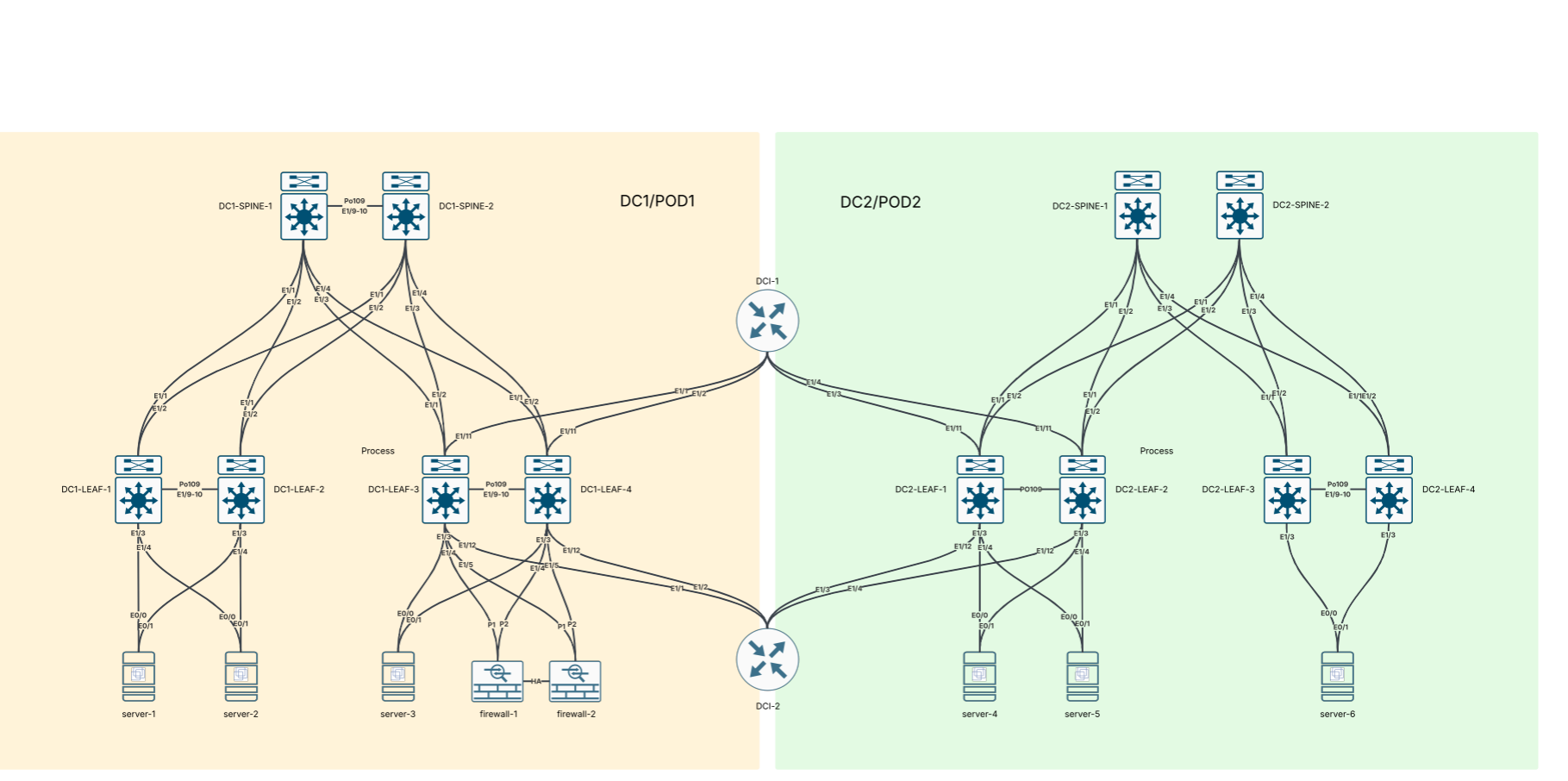
Build a real, dual-datacenter VXLAN EVPN fabric on Cisco NX-OS - from manual VXLAN encapsulation through a full BGP EVPN control plane, Layer 3 routing (IRB), vPC high availability, multi-tenancy, external connectivity, and Multi-Site DCI.
The launch will be soonCourse Highlights
Dual-Datacenter Fabric
Build a real, dual-datacenter VXLAN EVPN fabric utilizing Cisco NX-OS switches and spine-leaf architectures.
BGP EVPN Control Plane
Master MP-BGP EVPN, L2VPN address families, route types, MAC mobility, and advanced EVPN VXLAN features.
Inter-VXLAN Routing (IRB)
Deploy Symmetric IRB, Distributed Anycast Gateways, Tenant VRFs, and L3 VNIs for efficient routing.
vPC High Availability
Configure dual-active gateways using identical VTEP IPs for vPC pairs alongside seamless L2/L3 redundancy.
Multi-Site & DCI
Implement EVPN Multi-Site using Border Gateways (BGWs) for inter-site re-encapsulation and L2/L3 extension.
External Connectivity
Manage Border Leaf vs. Border Spine roles, route leaking, and external peerings to PE routers.
Real-World NX-OS Fabric Experience
Designed for CCIE Data Center candidates and working data center engineers who need real fabric build experience beyond slides and simulators.
This course gives you hands-on practice equivalent to the VXLAN EVPN scope of the Cisco CCIE Data Center lab exam.
- Data Plane to Control Plane: Start with manual VXLAN encapsulation before introducing the full BGP EVPN control plane.
- Production Deployment Models: Implement Symmetric IRB with Distributed Anycast Gateways and vPC high availability.
- Multi-Fabric Topologies: Build two independent spine-leaf data centers connected over a dedicated DCI pair using EVPN Multi-Site.
Technologies Covered
- ✓ VXLAN MAC-in-UDP Encapsulation
- ✓ MP-BGP EVPN Control Plane
- ✓ Type 2, 3, and 5 EVPN Routes
- ✓ Symmetric IRB & Distributed Anycast Gateway
- ✓ vPC High Availability (Anycast VTEP)
- ✓ Tenant VRFs & L3 VNIs (Multi-Tenancy)
- ✓ EVPN Multi-Site & Border Gateways (BGWs)
- ✓ External L2/L3 Connectivity & Route Leaking
- ✓ Multicast Data Plane & Ingress Replication
- ✓ ARP Suppression & MAC Mobility
Modules & Topics
- VXLAN terminology: VTEP, VNI, NVE, Bridge Domains, L2/L3 gateways, distributed vs. centralized gateways
- VXLAN encapsulation: MAC-in-UDP packet format and the 24-bit VNI
- Static VXLAN workflow using an ingress replication list
- VXLAN MAC address entries and ingress-replication MAC learning
- Packet forwarding: intra-subnet, inter-subnet, and BUM traffic
- Multicast data plane workflow and flood-and-learn MAC learning
- Lab: configure and verify ingress replication and the multicast data plane
- Introduction to MP-BGP EVPN and the L2VPN EVPN address family
- EVPN route types: Type 2 (MAC/IP), Type 3 (Inclusive Multicast), Type 5 (IP Prefix)
- Route Distinguishers and Route Targets for tenant isolation
- Advanced EVPN VXLAN features: ARP suppression, MAC mobility, VXLAN QoS
- Lab: configure MP-BGP EVPN, compare iBGP vs. eBGP overlay designs, and demo ARP suppression and MAC mobility
- Tenant VRF, L3VNI, and multi-tenancy concepts
- Deployment models for inter-VXLAN routing: centralized vs. distributed gateways
- IRB modes: Asymmetric vs. Symmetric IRB, and why NX-OS uses Symmetric IRB
- Distributed Anycast Gateway for VM mobility
- Lab: configure tenant VRFs, L3 VNIs, and SVI Anycast Gateways; demo multi-tenancy with route leaking between VRFs
- vPC and VXLAN traffic flow alongside L2/L3 redundancy (FHRP)
- Anycast VTEP: presenting a single VTEP IP across a vPC pair
- Lab: configure dual-active gateways using identical VTEP IPs for vPC pairs
- Lab: build multi-tenancy in the L2 fabric
- Lab: build multi-tenancy in the L3 fabric
- The border role: Border Leaf vs. Border Spine placement
- External Layer 2 connectivity to other L2 fabrics
- External Layer 3 connectivity: route leaking and Type 5 routes
- Lab: L2 extension via vPC on a Border Leaf, and a legacy-to-new DC migration scenario
- Lab: L3 extension with Border Leaf peering to an external PE router and route redistribution
- Multi-POD, Multi-Fabric, and Multi-Site concepts, use cases, and trade-offs
- Lab: implement EVPN VXLAN Multi-POD
- Lab: implement EVPN Multi-Site using Border Gateways (BGWs) for inter-site re-encapsulation
- Lab: multi-site L2 extension for a legacy-to-new DC migration scenario
Start Your Lab Experience
Lab Hours Booking
Reserve access to a dedicated, pre-wired lab environment and use your purchased lab hours whenever it suits you.
- Direct access via browser and internet connection
- Dedicated Catalyst Center and ISE controllers
- Full control over single fabric site & underlay
- Zero hardware required on your side
- Schedule your lab session for any available date and time